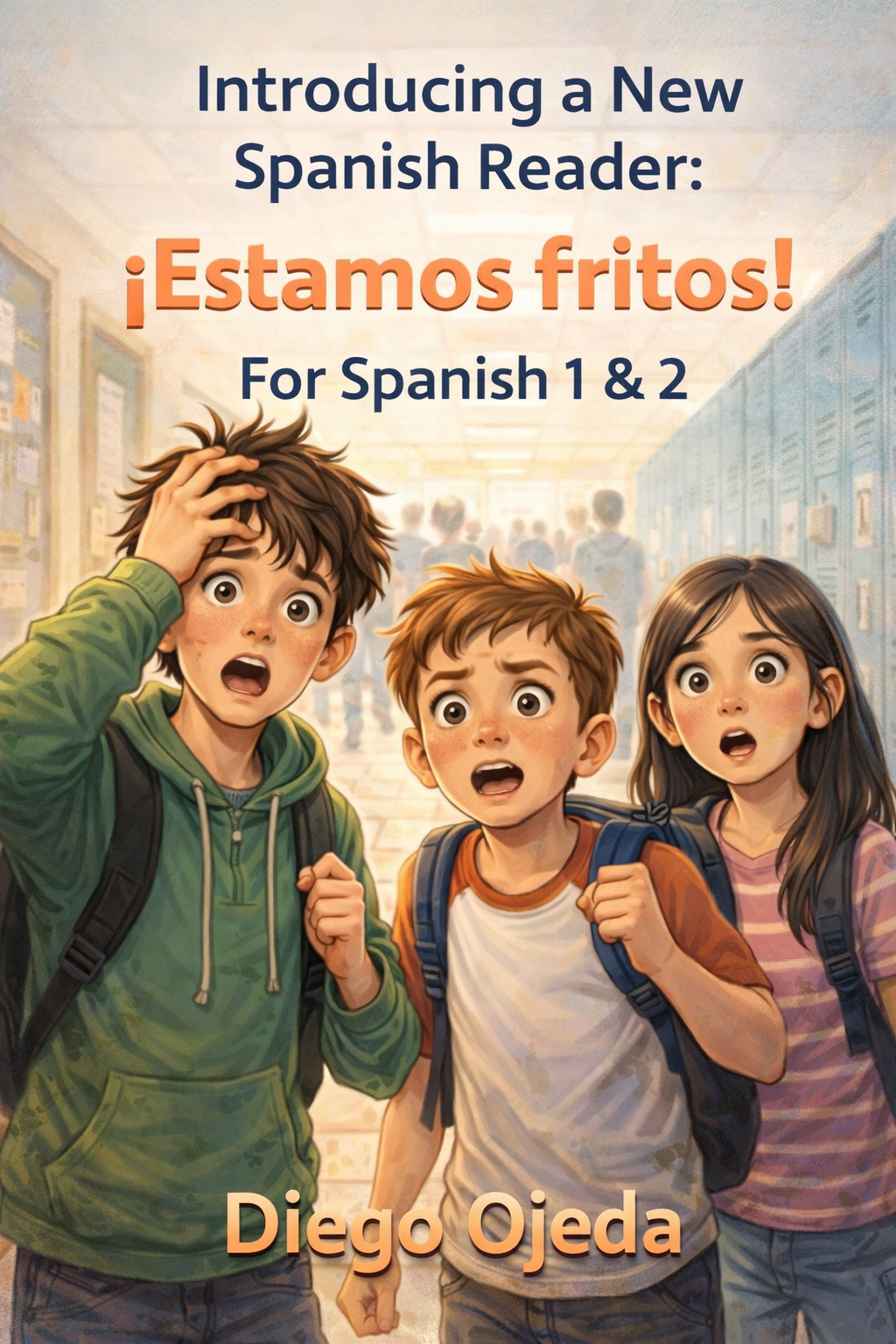
For many years, teachers have known me through my comprehensible poetry. Writing poetry for language learners has been one of the great joys of my professional life. Through poetry, I have tried to create texts that are accessible, meaningful, emotionally resonant, and genuinely enjoyable for students learning Spanish.
Now, after many years of writing comprehensible poetry, I am excited to take a new step: I am beginning to write readers for Spanish learners.
The first book in this new journey is ¡Estamos Fritos!, published on January 1, 2026, and I am deeply grateful for the warm reception it has already received from both teachers and students.
Why write a reader now?
During all these years of writing poetry, I have also been studying, presenting, and sharing about effective ways to work with reading in the language classroom. I have spent a great deal of time thinking about what makes a classroom text truly successful. I have also gathered and analyzed a considerable number of readings by different authors, always asking myself the same questions:
What keeps students reading?
What makes a text feel truly comprehensible?
What kinds of stories respect students, engage them, and support acquisition at the same time?
After this long period of teaching, observing, reading, studying, and reflecting, I felt ready to begin writing a series of books of my own—stories designed very intentionally for the classroom.
¡Estamos Fritos! is the first result of that process.
A reader designed for real students
This book tells the story of Max and his friends as they begin middle school and get pulled into what feels like a serious mystery. Max is dramatic, thoughtful, and a little anxious. His friend Sam is funny, energetic, and always ready to say, “Estamos fritos.” Luna is observant and calm. Bruno brings even more drama to every situation. Together, they turn ordinary school moments into what feels like a huge crisis.
At the heart of the story is a misunderstanding that grows chapter by chapter: a missing backpack, a teacher’s serious look, a mysterious notebook, a closed door, rumors, a secret file, and a growing suspicion that something very bad is happening.
Of course, the charm of the story lies in how students experience that mystery through Max’s perspective. The language remains simple, but the tension keeps building.
Lines like these show that balance between comprehensibility and suspense:
- “No tengo mi mochila,” dice Max.
- “Estamos fritos,” dice Sam.
- “La señora Gloria sabe algo.”
- “Esto es muy grave.”
The repetition is intentional. The language circles back in meaningful ways so that students gain confidence as they read.
Comprehensible, but not flat
One of my main goals with ¡Estamos Fritos! was to write a book that is not only comprehensible for Spanish 1 and Spanish 2 students, but also truly readable.
Sometimes beginner readers are simplified so much that they lose their energy, personality, or charm. I wanted to avoid that.
This story uses repeated high-frequency structures and familiar vocabulary, but it still feels like a story. Students are not simply decoding language; they are following a plot, making predictions, noticing clues, and wanting to know what happens next.
By the time a student has read about 25% of the book, they are already familiar with a large portion of the vocabulary that will help them continue successfully. That repeated exposure matters. It lowers stress, increases confidence, and makes the reading experience feel possible.
Humor that feels safe and human
Another important decision I made was about humor.
I wanted this book to be funny, but in a healthy and steady way. Not exaggerated humor that becomes chaotic. Not sarcasm that could feel sharp or uncomfortable for students. Not humor that depends on embarrassing characters or hurting someone’s dignity.
Instead, I wanted the humor in ¡Estamos Fritos! to feel light, human, and classroom-friendly.
Sam’s repeated “Estamos fritos” becomes funny because of how often he says it and how dramatic he is, not because the story is making fun of anyone. Bruno’s intense theories add humor. Max’s tendency to overthink adds humor. But the tone stays kind.
That matters to me as a teacher and as a writer.
Cultural details that are natural and respectful
I also wanted the book to feel culturally sensitive in ways that are authentic and natural, not forced.
Max lives in a bilingual, bicultural home. His father is Colombian. His mother is American. Sam also lives between cultures, with a Peruvian mother and an American father. These details are not presented as decorations; they are simply part of who the characters are.
The story includes meaningful moments like Max bringing an arepa for lunch and Sam bringing purple juice from home. Those details are small, but they matter. They help create a world that feels real, familiar, and respectful. They remind students that culture lives in everyday life: in food, family, language, identity, and perspective.
I wanted the cultural elements in the book to feel lived, not performative.
A little mystery goes a long way
Middle school and early high school students want texts that move. They want stories with tension. They want a reason to keep turning the page.
That is why I decided to incorporate a touch of mystery and suspense into this reader.
What is the notebook?
Why is Max’s name underlined?
Why does the teacher keep looking at him?
What is happening behind the closed door?
What do the words “confianza, cambio, apoyo” really mean?
These questions give the story momentum. Even students who are still developing confidence in reading can stay connected because they want answers.
And in the end, the resolution matters too. The mystery is not dark. The suspense does not become heavy. The story resolves in a way that is reassuring, thoughtful, and meaningful for young readers.
Who is this book for?
¡Estamos Fritos! is designed for:
- Spanish 1 and Spanish 2
- High school students
- Middle school students who have at least a Novice Mid level of proficiency and will therefore feel more comfortable reading it
It is especially appropriate for teachers who want a reader that is accessible but not childish, funny but not silly, suspenseful but still safe, and culturally grounded without becoming overwhelming.
More than a story
For me, this book is more than a new publication. It represents a continuation of my work as an educator.
Everything I have learned through teaching, writing, presenting, studying, and reflecting has shaped this project. ¡Estamos Fritos! was created not just to be read, but to be used in real classrooms with real students who need texts that invite them in.
I wanted to create a story that says to students:
You can read this.
You can enjoy this.
You can stay with this story until the end.
And I wanted to create a resource that says to teachers:
Here is a book built with intention.
Here is a story shaped by years of classroom experience.
Here is a reader that understands both language acquisition and the emotional reality of students.
An invitation to teachers
If you are looking for a reader for Spanish 1 or 2 that combines comprehensibility, healthy humor, cultural sensitivity, repetition, suspense, and heart, I would love for you to bring ¡Estamos Fritos! into your classroom.
Max and his friends may think they are in trouble, but what they really discover is something much more meaningful: support, trust, friendship, and the possibility of growth.
And maybe that is exactly what many of our students need to discover too.
Get ¡Estamos Fritos! HERE. Feel free to email me for a special discount should you want to buy 10 or more copies.
Enjoy my posts?
Get my newsletters with strategies, classroom activities, and encouragement every month. Sign up HERE
 DIEGO OJEDA
Two of my students used the expression “ Estamos Fritos “ in a real conversation ! I thought that was very unique. I read the whole book as soon as I got it, and I did see all the components you mentioned. They create a high quality plot targeted to novice language students.
LikeLike
Mil gracias Profe Diana.
LikeLike
👍💕
LikeLike