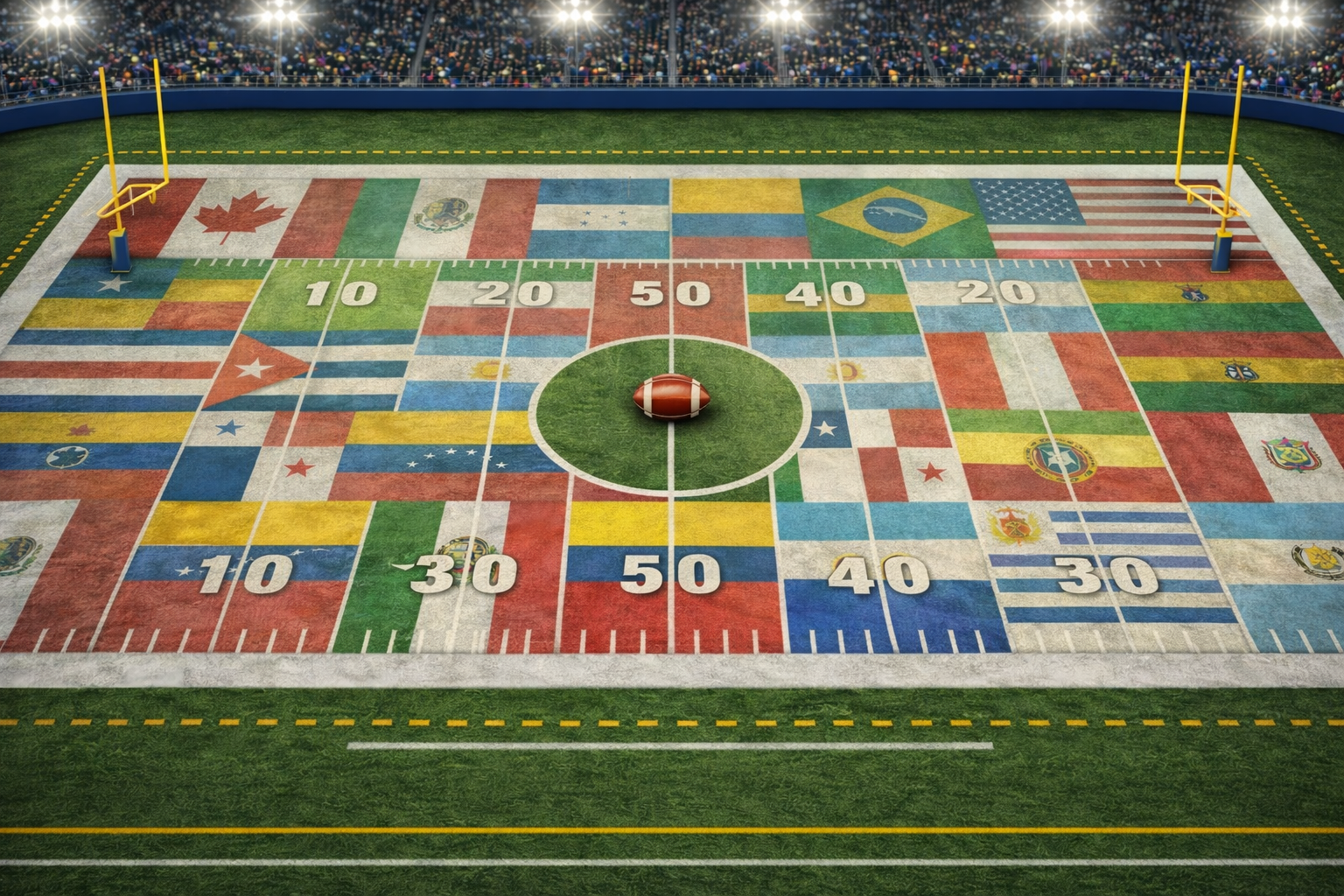
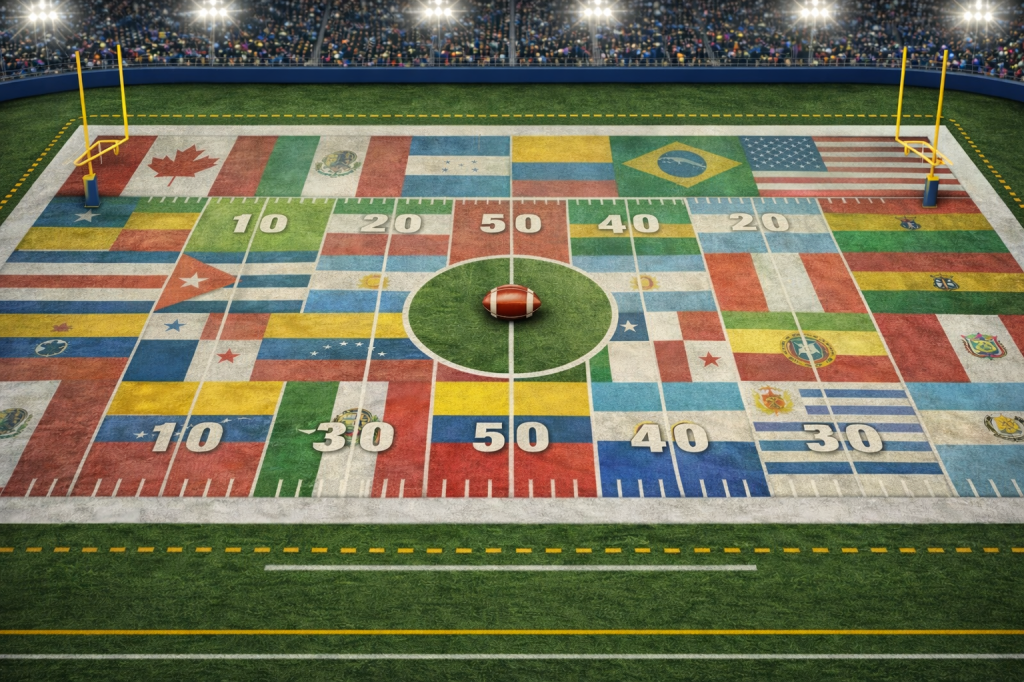
In my AP Spanish Language class, we recently watched the Super Bowl halftime performance by Bad Bunny during the Super Bowl. We didn’t watch it just for entertainment. We watched it as a text.
We analyzed it.
We unpacked it.
We talked about symbolism, cultural references, tone, audience, and message.
And then I asked my students to write a reflection. What they wrote moved me deeply.
“America Is Two Continents, Not Just a Country”
One of the strongest themes that emerged from their reflections was this idea:
America is not just the United States.
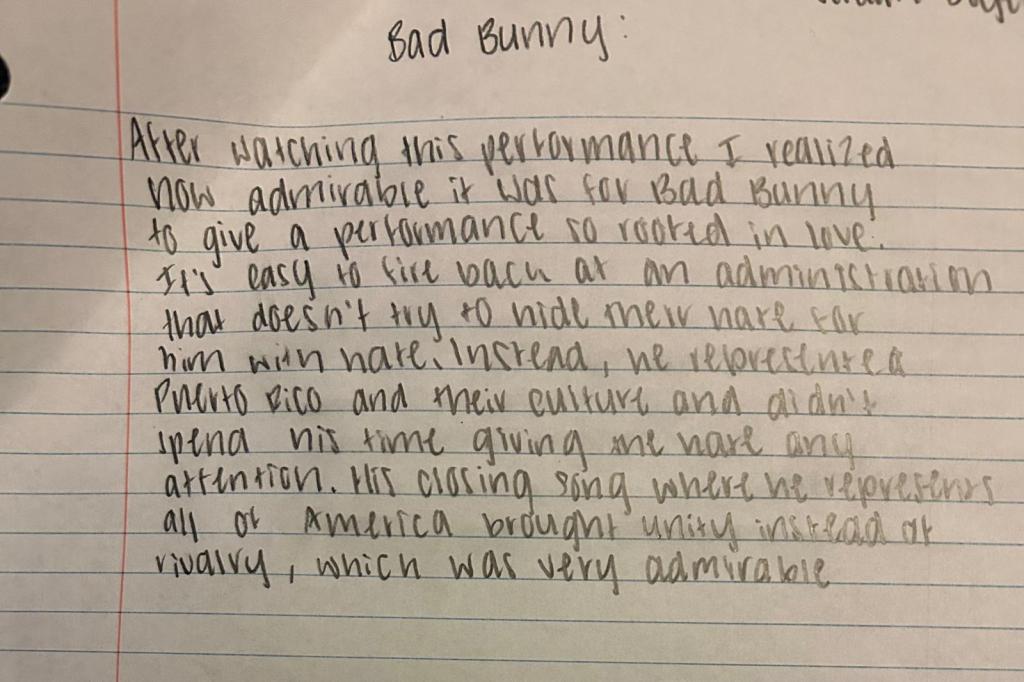
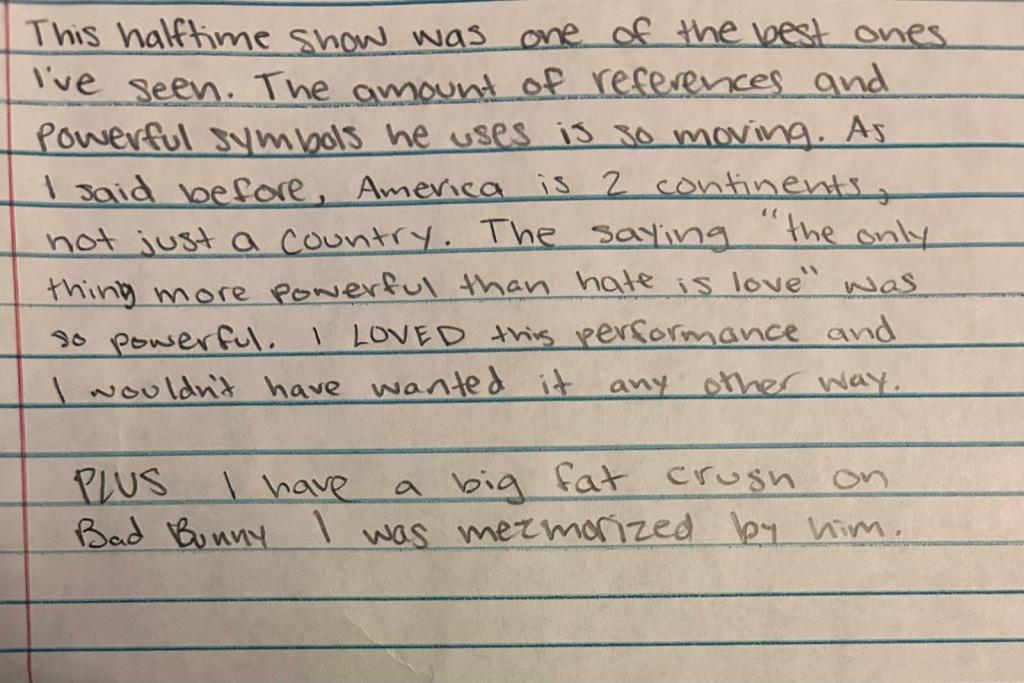
Several students pointed out how powerful it was to see a global stage used to remind viewers that America is two continents, made up of many nations, histories, and identities. They recognized how intentional the cultural references were, how Puerto Rico was centered without excluding the rest of Latin America. For many of them, this wasn’t just a music performance. It was a redefinition of space. A widening of perspective.
And that realization mattered.
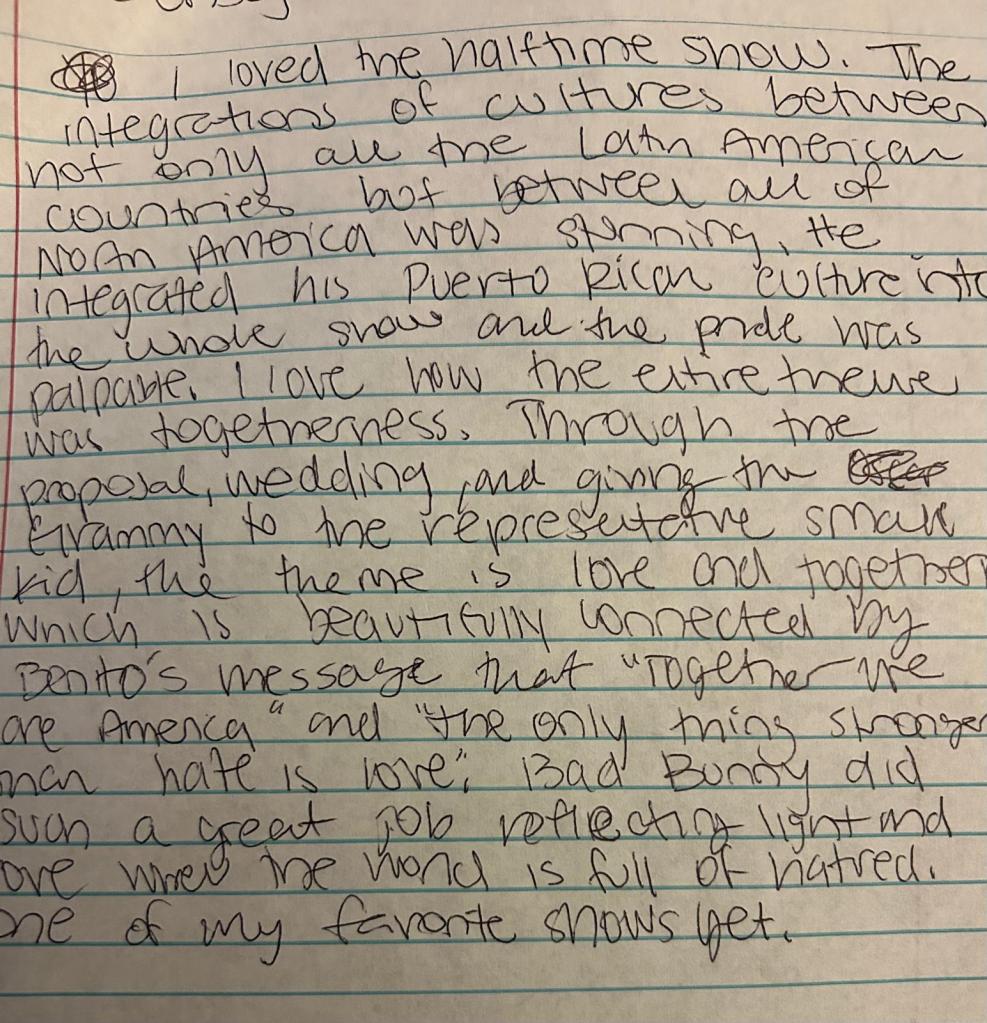
The Power of Symbolism
Students repeatedly described the show as “moving,” “beautiful,” and “powerful.”
They noticed the symbolism:
- The proposal representing unity.
- The passing of the Grammy to a child, symbolizing hope and the future.
- The integration of Latin American culture into a traditionally U.S.-centered event.
- The closing message that the only thing stronger than hate is love.
One student wrote that even though they didn’t understand every word, the energy, pride, and soul of the performance were undeniable. Another reflected on how easy it would have been to respond to hostility with hostility, but instead, the performance chose love.
That choice struck them.
Representation Beyond Identity
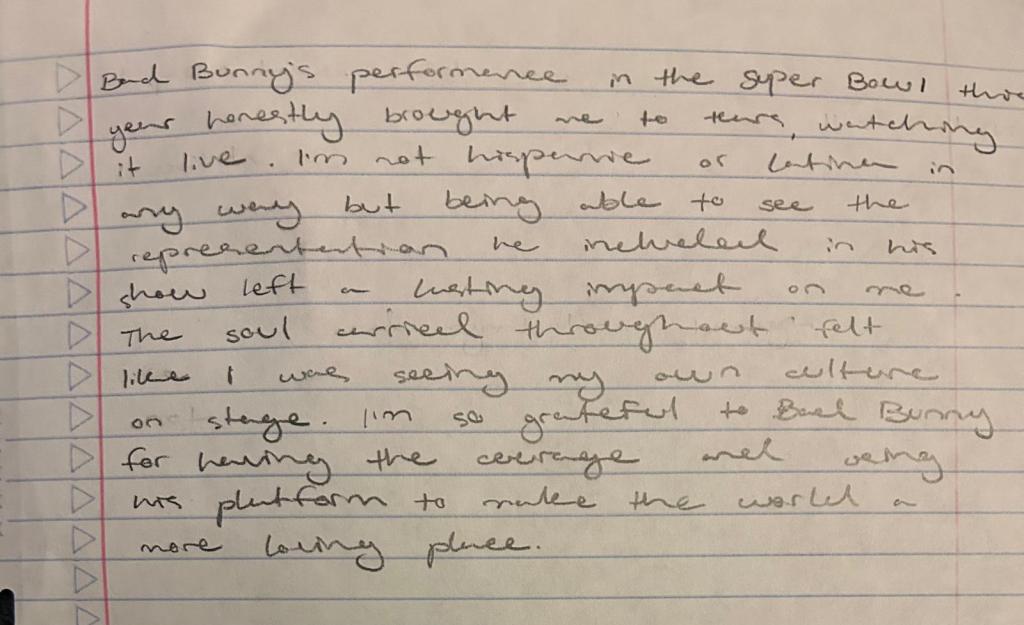
What impacted me most was reading reflections from students who do not identify as Hispanic or Latino but who still felt deeply connected to what they saw.
One student wrote that watching the performance felt like “seeing my own culture on stage,” even though it wasn’t literally theirs. Another admitted they didn’t fully grasp the cultural references at first, but after we analyzed them together in class, the meaning became even more powerful.
That is what education does.
It slows down the moment.
It gives language to feeling.
It transforms entertainment into understanding.
Pride Without Apology
My students recognized something essential: the performance did not beg for acceptance. It did not center on conflict. It did not give hate the spotlight.
Instead, it celebrated Puerto Rican identity boldly and unapologetically.
It fused cultures instead of dividing them.
It elevated unity over rivalry.
One student wrote that the pride was “palpable.”
Another said they were brought to tears.
And perhaps the most profound reflection of all was this:
The show demonstrated that love is stronger than hate—not by saying it loudly, but by embodying it.
Why This Matters in an AP Classroom
In AP Spanish Language, we analyze persuasive techniques, cultural products, and global themes. But sometimes the most meaningful texts are not printed on paper.
Sometimes they happen on a stage.
By watching this halftime show critically, students practiced:
- Cultural comparison
- Interpretation of symbolism
- Global awareness
- Intercultural understanding
- Personal reflection grounded in analysis
But beyond the academic skills, they practiced something even more important: empathy.
They saw how art can affirm identity.
They saw how representation can unify rather than divide.
They saw how culture can be celebrated without diminishing anyone else.
A Halftime Show That Became a Lesson in Love
What struck me most as I read their reflections was not just their analysis—it was their growth.
They understood that:
- America is larger than one nation.
- Culture deserves space on global platforms.
- Pride and love can coexist with resistance.
- Unity is stronger than rivalry.
As one student beautifully put it, the performance reminded them that “together we are America.”
And if a halftime show can spark that kind of reflection in a classroom, then it has done far more than entertain. It has educated.
Enjoy my posts?
Get my newslwtters with strategies, classroom activities, and encouragement every month. Sign up HERE
 DIEGO OJEDA