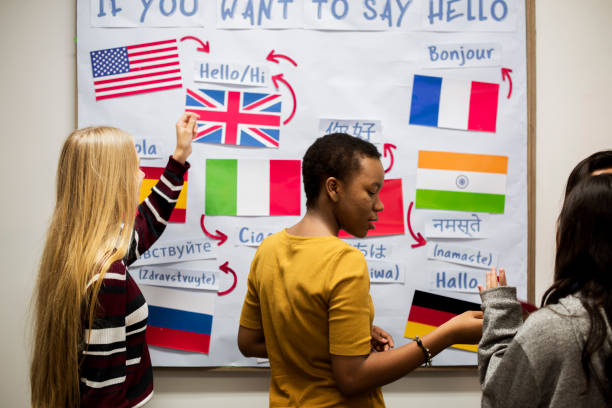
Recently I had the opportunity to present a webinar for Klett World Languages on a topic that has shaped my teaching more than anything else: building community in the world language classroom. After many years of teaching, I can say with absolute certainty that language acquisition simply does not happen without emotional connection. Students learn when they feel seen, valued, and welcomed into a space where their voices matter.
And the best part? You can begin building that kind of classroom at any moment of the school year—August, November, March, even a week before summer break. It is never too late to transform the classroom into a place where students genuinely want to show up.
At the Door: Where Community Begins
The first moments before class set the tone for everything that follows. Greeting students at the door—looking them in the eyes, acknowledging them by name, offering even the simplest greeting in the target language—communicates something powerful: You belong here. I am ready for you.
Many times, we are busy preparing materials, fixing the projector, or catching up on emails and forget how much students notice our tone, posture, and presence. Standing at the door has become one of the most effective habits in my classroom. Even if students walk in distracted or with an attitude, that moment of connection matters. First impressions stick, and greeting students consistently helps them understand that Spanish class is not just another room—it’s their space, too.
Teaching with Humanity and Authenticity
One of the misconceptions in our profession is that professionalism means being perfect, polished, and scripted. In reality, students connect most deeply with teachers who are authentic, warm, and consistent. The person we are in the hallway should be the same person they see in the classroom.
We all have tough days, and on those days we sometimes need to rely on our “inner actor” to protect our students’ emotional space. This doesn’t mean being fake; it means choosing calm, kindness, and gentleness even when we’re tired. Students mirror our energy. If we perform calm, they feel calm. If we perform stress, they will feel it. Consistency builds trust, and trust builds community.
Humor also plays a central role. A simple facial expression or an exaggerated reaction can create a moment of joy. And our accents—far from being a flaw—are gifts that connect culture and identity. Students love when we share small stories about our lives, our passions, or our own language struggles. These moments humanize us and strengthen the classroom community.

Creating a Safe and Welcoming Environment
Safety in the classroom is emotional as much as academic. During the first week, it’s perfectly fine to rely on students’ first language to explain expectations, share who we are, and introduce the idea of language acquisition. A simple script explaining how their brains acquire language gives them confidence and reduces anxiety. It helps them trust the process long before they understand every word in Spanish.
One practice that has transformed my classes is building the room together. Instead of decorating every wall before the first day, I keep the walls intentionally bare. Then I invite students to bring something meaningful—an object, photo, drawing, or word—to display. Over the first month, the walls slowly fill with their stories. This approach not only creates a visually rich environment but also shows students that their identities matter.
Every object—whether a concert ticket or a shoelace—carries a story. When a classroom wall honors all of them equally, students learn that their experiences, memories, and cultures are valid and valuable.
The Three Pillars of a Strong Classroom Community
Although I avoided listing them as steps in the webinar, the main ideas flow from three central concepts. A strong classroom community grows when activities are engaging, when culture is explored with empathy and depth, and when students collaborate often and meaningfully.
When activities are compelling, students participate willingly because they are curious, not because they are required to. When culture is approached through stories, perspectives, and real connections rather than through stereotypes, students gain a deeper understanding of the world. And when collaboration is part of daily routines—through conversations, small-group structures, peer interviews, and shared stories—students learn with each other instead of relying only on the teacher.
These three elements work together to create a classroom where students feel emotionally safe and intellectually curious, a combination that is essential for language acquisition.
A Classroom That Feels Like a Community
A world language classroom should feel a little like a café—a social space where students come to talk, listen, laugh, and connect in another language. Sometimes this means rearranging the furniture, playing soft music, or creating a routine conversation circle. Sometimes it simply means offering students the space to share their stories or giving them moments of autonomy.
Community does not equal control. It’s not measured by silence. A strong community is full of laughter, movement, honesty, and respectful risk-taking. Students behave not because they fear us, but because they care about the space and the people in it.
This kind of classroom is also capable of handling meaningful, real conversations about culture, identity, migration, and equity. When trust is present, these topics become opportunities to build empathy instead of barriers that divide.
Final Thoughts
Building community is not about adding more tasks to an already full plate. It’s about approaching our students with intentionality, warmth, and curiosity. It’s about the small, daily moments that signal to students: You matter here.
And if you’d like to explore these ideas in more depth, hear the stories, and see the examples I shared during the live event, I invite you to watch the full webinar HERE:
Want more ideas like these?
Get my newslwtters with strategies, classroom activities, and encouragement every month. Sign up HERE



me fascina su contenido y uso sus este en clase. Muchas gracias por todo lo que nos imparte.
LikeLike
Con mucho gusto Claudia. saludos
LikeLike