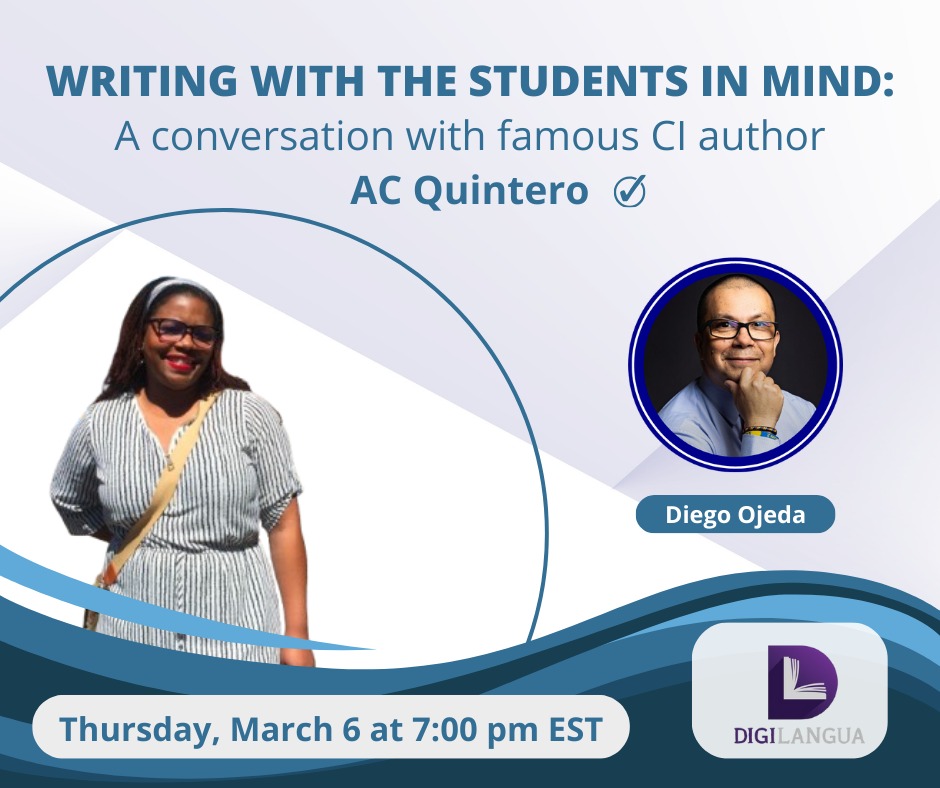

A Conversation with A.C. Quintero: Insights for World Language Teachers
In a recent webinar, I had the pleasure of chatting with A.C. Quintero, a respected figure in the Comprehensible Input (CI) community. As a teacher and writer, Quintero shared her wealth of experience in the classroom and offered valuable insights into the power of language and literature in shaping students’ learning journeys. For language teachers, this conversation was full of inspiration and practical advice we can apply to our own teaching practices.
A Journey into Education
A.C. Quintero’s path into teaching is one that many of us can relate to. She started her career in education over 20 years ago, beginning at the middle school level in International Baccalaureate (IB) schools. It was there that Quintero developed her student-centered teaching approach, which has been the foundation of her career ever since. As she transitioned into high school teaching, she continued to nurture her passion for creating meaningful connections with students.
Interestingly, Quintero didn’t always know she wanted to be a teacher. In fact, growing up, people often told her that she’d make a great lawyer because of her ability to argue and communicate well. But when she took Spanish classes to better connect with her Spanish-speaking friends in college, she realized her true passion for the language. This sparked her deep interest in Spanish literature and led her to a fulfilling career in teaching.
Personal Connections: A Teacher’s Secret Weapon
What’s unique about Quintero’s story is how she first connected to Spanish—not through textbooks, but through real-life relationships. Her love for the language grew from her interactions with Spanish-speaking individuals, and this personal connection is something she emphasizes in her own teaching. Quintero recalls reading books in Spanish as a child, such as Escalofríos (Goosebumps) and El último judío de España (The Last Jew of Spain), which helped her connect with Spanish language and culture on a deeper level.
Her passion for literature grew even further as she explored the works of Cuban author Alejo Carpentier. Although she didn’t fully understand his work at first, she later gained a deep appreciation for it—especially his exploration of the Haitian Revolution. This experience of revisiting literature and uncovering new meanings is something Quintero encourages her students to embrace.
From Self-Help to Fiction: A Teacher’s Reading Journey
Quintero also shared an interesting aspect of her own reading journey. As a young reader, she gravitated toward self-help books, thanks to her mother’s influence. While she still enjoys self-help books in English, Quintero now prefers fiction in Spanish. This preference reflects her deeper connection to the stories and characters in Spanish-language literature, which she uses to enrich her teaching and connect with her students.
Watch the conversation here:
Teaching: The Fulfillment of Connecting with Students
When Quintero talked about what inspires her to keep teaching, it was clear that her passion for her students is what drives her. She finds immense satisfaction in watching her students grow and seeing them apply their Spanish skills in the real world. For Quintero, there’s nothing more rewarding than hearing from students years later about how they’ve used Spanish in their careers, travel, or everyday life. This sense of fulfillment is what keeps her motivated, even on the toughest days.
Her time teaching in the IB program has helped her cultivate a holistic teaching approach that encourages critical thinking and deep learning. For Quintero, teaching isn’t just about language—it’s about fostering a love for learning that extends beyond the classroom. She also shared valuable tips on how to prepare high school students for college-level Spanish, which can help us all think about how to guide our students toward continued growth after graduation.
Keeping the Journey Going
What stands out most in Quintero’s story is her unwavering dedication to her students and her love for teaching. Her experience in both the classroom and as an adjunct instructor has shaped her into an educator who is always looking for new ways to inspire her students. Whether it’s through personal connections to the language, engaging with literature, or finding new teaching strategies, Quintero’s journey reminds us that we can continue growing as educators while making a meaningful impact on our students.
For language teachers, Quintero’s story is a powerful reminder that our work isn’t just about teaching grammar or vocabulary—it’s about building connections, fostering a love for language, and helping students understand the world through the lens of another culture. Quintero’s experiences show us that even small connections can have a big impact, both in and outside the classroom.
Conclusion: A Story to Inspire Our Own Teaching
A.C. Quintero’s story is one that resonates deeply with language teachers. Her dedication to her students, passion for literature, and thoughtful approach to teaching are all things we can take inspiration from in our own classrooms. The next time you’re feeling drained or wondering about the impact you’re having, remember Quintero’s story and how her deep connections to language and students continue to fuel her work.
For all of us teaching world languages, Quintero’s journey reminds us of the power we have to shape our students’ futures, not just through language, but through the relationships we build and the love for learning we foster. It’s a beautiful journey, and as Quintero’s story shows us, it’s one that’s always worth continuing.
Here are AC Quintero´s media kits should people want to learn more about her and her resources.
 DIEGO OJEDA